Kořínek Real: Complete Brand and Website
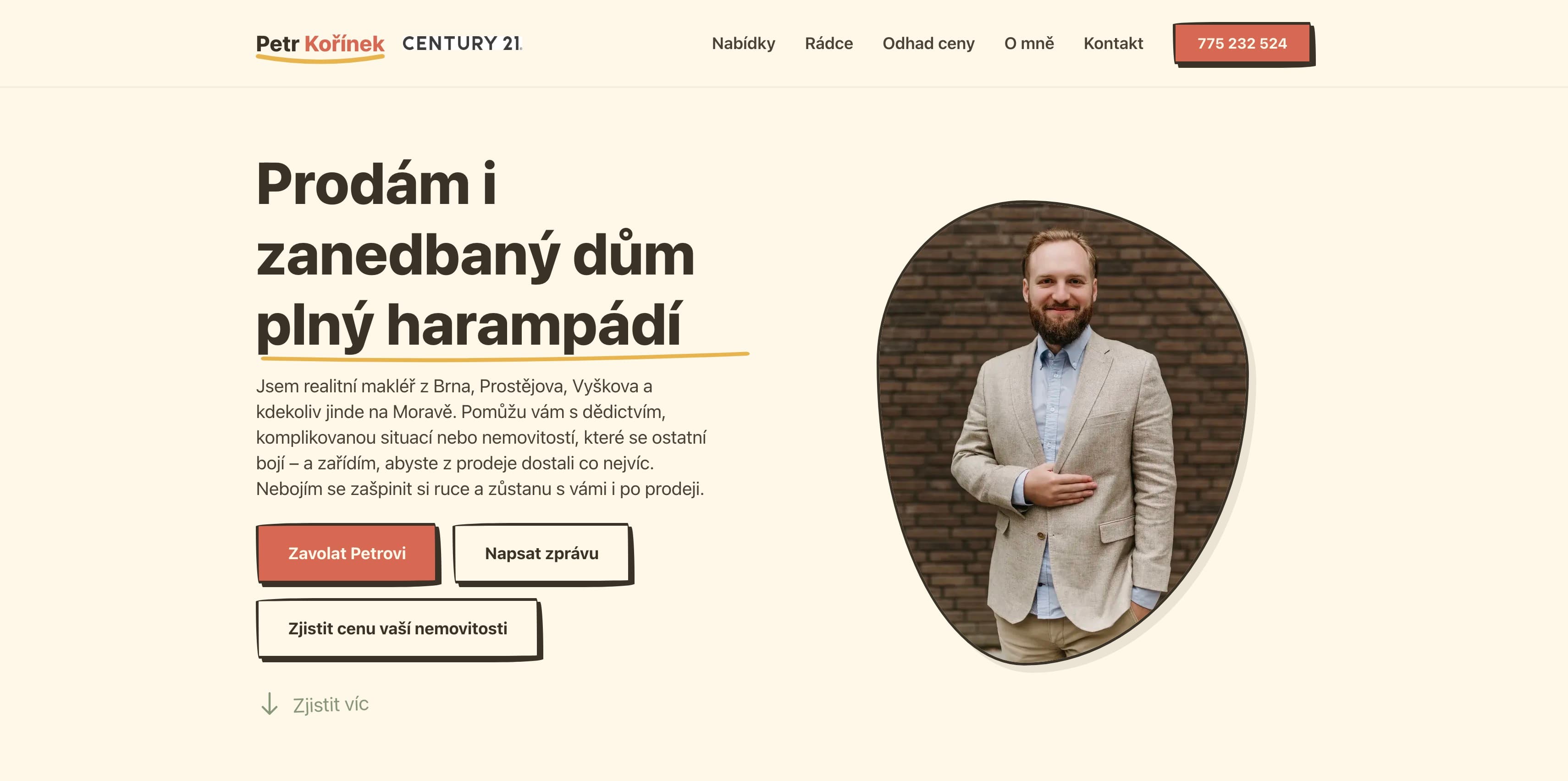
Petr Kořínek is a real estate agent. One of thousands. He sells apartments and houses in Brno, Prostějov, and Vyškov - just like dozens of others in these cities.
And that was exactly the problem we were solving.
From Sprint to Build
This project started as an AI Sprint - four hours of intensive work where we explored how to connect real estate work with artificial intelligence, how to build a personal brand with these tools, gain an advantage over competitors, and generate loads of leads. But when we saw where it was heading, we decided to go further. The sprint became a complete build.
What We Were Actually Building
This wasn't a "let's make a website" project. This was a complete personal brand project:
- Strategy - Who is Petr? How is he different? Why should a client choose him?
- Visual Identity - Colors, typography, communication style, design system
- Website - The place where it all lives and works for him 24/7
Three equal parts. Each built on the previous one. None can be skipped.
Part 1: Personal Brand
Why Personal Branding at All?
The real estate market is oversaturated. Every agent has business cards, everyone has "professional approach" and "individual care." They all say the same thing, look the same, and the client ends up choosing whoever their mother-in-law recommends.
But personal branding isn't about a logo and nice colors. It's the answer to the question: Why you?
With Petr, we searched for that answer - and found it where I wouldn't have looked myself. Not in his experience or certificates, but in his approach to people. In how he talks, how he explains, how he handles sellers' stress.
This is work I've been doing for years. Strategic marketing, brand building, finding what makes a person or company different. Normally, I would spend several hours in conversations with a client, taking notes, looking for patterns in what they say.
But this time I had a different situation.
Four Real Estate Agents, One Room, Two Hours
I was working with four real estate agents at once. Literally - they were sitting in one room and I had two hours to extract the foundation of a personal brand from each of them.
Four different people. Four different stories. Four different strengths. And just me.
The classic approach wouldn't work. I can't conduct four deep interviews in parallel.
So I created a chatbot.
In ChatGPT, I built an assistant where I uploaded:
- The structure of the interview I would conduct myself
- Questions about motivation, values, what they enjoy and what they don't
- Instructions on how to ask follow-up questions
- An output template - what the personal brand proposal should look like
Each agent got a link and started "conversing" with the bot. I walked between them, helped when someone didn't know how to answer, explained context.
After two hours, each of them had the first draft of their personal brand.
Why it worked better than the classic approach:
- No one waited for their turn
- Everyone could think at their own pace
- No one felt the pressure of a "live" interview
- I got a consistent structure from all four
- And most importantly - people are surprisingly open when talking to a bot
The output wasn't perfect. But it was a solid foundation that I then worked with further - adjusting, refining, finding what resonated in the text and what didn't.
This is the essence of what I do. Tech meets human. Technology allowed me to scale work that would otherwise be time-prohibitive. But the final decisions, adjustments, the sense of what works - that was me.
Part 2: Visual Identity and Prototype
Once I had Petr's brand - his tone, his values, his differentiator - I needed to translate it into visuals.
I used Gemini Canvas to generate a static website. I described what I wanted - colors, style, structure. And then I iterated. Again and again, until the design fit what Petr represents.
The result was a nice one-pager. Modern, responsive, with Petr's story and contact. And most importantly - with a visual identity that's his. Colors, typography, illustration style with a hand-drawn font for accents.
For most people, this would be enough. Throw it on hosting, connect a domain, done.
And honestly - if Petr wasn't a friend and didn't have bigger ambitions, we would have stopped here. I host similar static pages on Váš Hosting, where it costs a few hundred crowns a year and works reliably. (This is an affiliate link - if this article helps you decide to go there too, please use it.)
But Petr wanted more. And I wanted to see how far I could take it.
Part 3: Production Website
Why WordPress Stopped Being Enough
For years I made websites on WordPress. It's a classic - huge community, thousands of templates, a plugin for everything.
But that "plugin for everything" gradually became the problem.
I want a contact form? Plugin. I want a gallery? Plugin. I want SEO? Plugin. I want faster loading? Plugin. And suddenly I have a website with twenty plugins that fight each other, need updates, and I spend more time managing infrastructure than creating content.
And I still can't have things exactly how I want. I'm limited by what someone programmed. Every customization outside the template means digging through PHP code that's twenty years old.
I'd been looking for an alternative for a while. And this project was the opportunity to find it.
Enter Claude
This is where the interesting part begins.
I sat down with Claude and said: "I need to make a website for a real estate agent. Not a template, but something that will really work. What would you recommend?"
And Claude did research.
He went through what the best real estate websites do. What structure they have. What works for SEO. How they handle lead generation. What technologies they use and why.
I checked, asked questions, discussed. Some things I rejected, some I expanded. But the basic strategic work? Claude did that.
Research results:
A real estate website needs:
- Dynamic property listings (that change)
- Client references (that grow)
- Articles and guides (for SEO and credibility)
- Local SEO pages (for each city separately)
- Calculators and tools (for lead generation)
- Speed and mobile optimization (Core Web Vitals)
A static page from Gemini can't do this. I needed something more robust.
Technologies Claude Chose
I'll be honest: I knew practically nothing about Next.js before this project.
Claude suggested the tech stack and I trusted him. But not blindly - I had him explain why each choice.
Next.js (framework)
React framework from Vercel. Why this one?
- Server-side rendering - pages are generated on the server, so they're fast and SEO-friendly
- App Router - modern way of organizing code that makes sense
- Automatic optimization - images, fonts, everything optimizes itself
- Vercel deployment - I upload code and in a minute it's running in production
Alternatives were Astro, Remix, or classic React. Claude explained the trade-offs and for a real estate website with dynamic content, Next.js made the most sense.
Tailwind CSS (styling)
Utility-first CSS framework. Instead of writing your own CSS classes, you use pre-prepared utilities.
Sounds like a step back, but in practice it's brutally fast. And most importantly - consistent. I don't worry about whether margin should be 16px or 18px. Tailwind has the design system built in.
Sanity (CMS)
Headless CMS for content management. This is a game-changer.
Traditional CMS (WordPress) has content and presentation together. Sanity separates data from presentation. Petr can add properties through a clear interface, and the website pulls them via API.
Why Sanity and not another headless CMS?
- Generous free tier (10,000 API requests per month)
- Great interface for the client
- Real-time preview of changes
- Flexible data structure
Resend (emails)
Service for sending transactional emails. When someone fills out the contact form:
- Petr gets a notification with details
- The client gets confirmation that their message arrived
More reliable than sending emails directly from the server, 100 emails per day free.
Vercel (hosting)
Platform from the creators of Next.js. Zero-config deployment - I connect GitHub repo and every push to main branch automatically deploys a new version.
Free tier is enough for most projects. You only pay when you have really big traffic.
Claude Code: Where It All Got Built
Research and planning happened in regular Claude chat. But the actual implementation I did in Claude Code.
It's a CLI tool where Claude has access to files on disk. It can read code, write code, run commands. And most importantly - it sees the context of the entire project.
The workflow looked like this:
-
Description of what I want - "I need a component for a property card. It should display a photo, price, location, and status (active/sold)."
-
Claude writes code - Creates files, imports, TypeScript types.
-
Review - I look if it makes sense. I ask about things I don't understand.
-
Iteration - "Add a badge with photo count. And adjust spacing."
-
Testing - I run locally, see how it looks.
-
Next feature - Repeat from step 1.
The key is that Claude always saw the entire project. He knew what components already exist, what the design system is, what the TypeScript types are. New code was consistent with existing code.
I made creative and strategic decisions. Claude did implementation. And when I didn't understand something, he explained it to me.
Result
The website korinekreal.cz is live. It's fast, responsive, and most importantly - it's Petr's. It's not a template with a swapped logo. It's a website that reflects his approach, his personality, his way of working.
What the Project Includes
Strategic part:
- Personal brand and positioning
- Differentiation from competition
- Communication tone and values
Visual part:
- Color palette and typography
- Design system with hand-drawn font for accents
- Consistent visual language across the entire website
Technical part:
- Dynamic property listings managed through CMS
- Price estimate calculator (that also collects leads)
- Local SEO pages for each city
- References and articles
- Automatic emails from contact form
Website Structure
korinekreal.cz/
├── Main page (hero, services, references, CTA)
├── /nabidky/ (active properties)
├── /prodano/ (sold portfolio)
├── /radce/ (blog with articles)
├── /reference/ (client reviews)
├── /lokalita/brno/ (local SEO)
├── /lokalita/prostejov/
├── /lokalita/vyskov/
└── /kalkulacky/odhad-ceny/ (lead generation)
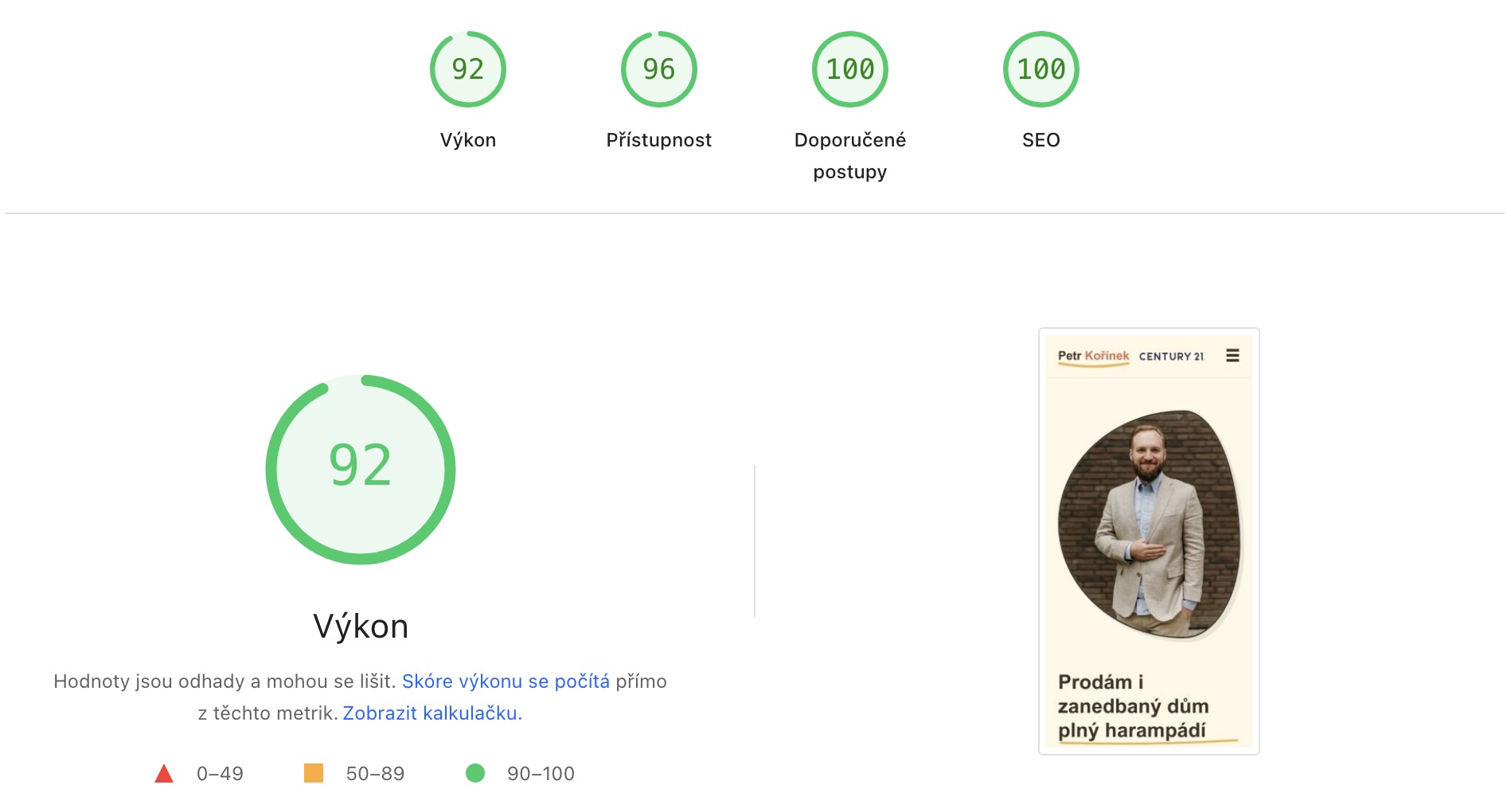
Lighthouse Score
Running Costs
- Vercel: $0 (free tier)
- Sanity: $0 (free tier)
- Resend: $0 (100 emails/day free)
- Domain: ~$12/year (.cz domain)
Total: ~$12/year - only domain
What This Means
The entire project took a week. Not because I worked sixteen hours a day, but because AI dramatically accelerated every phase.
Phase 1: Personal Brand - ChatGPT bot allowed me to scale work that would otherwise take many times longer.
Phase 2: Visual Identity - Gemini Canvas provided the visual foundation in hours, not days.
Phase 3: Production Website - Claude Code built a website that I couldn't have written myself (without knowing Next.js).
But - and this is important - AI didn't replace thinking.
I decided on strategy. On what the brand should communicate. On which features make sense and which are unnecessary. On when something is "good enough" and when it needs more work.
AI gave me superpowers in areas where I'm weak (programming). But areas where I'm strong (strategy, marketing, communication) - those stayed with me.
This is tech meets human in practice.
You don't need to be a programmer to have a professional website. You don't need to spend months learning frameworks. But you need to know what you want. You need to be able to recognize quality. You need to make decisions.
Technology is a tool. Like a hammer. Like an IDE. Like a pen.
What matters is what you do with that tool.